
Beton + PostHog
Your product analytics, powering revenue intelligence
Connect your PostHog instance as the primary data source for behavioral signal detection. Backtest hypotheses on your event history before any signal goes live.
PostHog as the primary signal source for revenue intelligence
PostHog is the system most product-led companies use to capture user behavior, and it's almost always the right place for Beton to start. Every event your product emits — pageview, feature use, identify, group association, custom events — already lives in PostHog with the timestamp and the person/group context Beton needs to look at conversion patterns. Pulling that data into a separate warehouse just to run signal detection adds a pipeline and a copy of your data without adding any signal that wasn't there to begin with.
Beton's PostHog integration reads events directly from your instance — Cloud or self-hosted — using the standard PostHog API. The agent inspects your event taxonomy and person/group properties, proposes signal hypotheses, and backtests each one against the last 90 days of your data before any signal is allowed to route. You see precision, recall, and lift before you decide to promote. Hypotheses that don't beat your bar never fire; hypotheses that do flow into your CRM continuously as new events come in.
Patterns Beton typically surfaces in PostHog data
- Activation depth — users who explore three or more core features in their first session, beyond the one feature they signed up for. The breadth signal usually predicts conversion better than depth on any single feature.
- Collaboration milestones — invitations sent, shared resources created, comments posted. The first invite is the strongest single predictor in most B2B PostHog data because it converts an individual evaluator into an organizational champion.
- Integration adoption — connecting a third-party tool from your product (a Slack, a CRM, a GitHub). High-cost actions that almost always correlate with retention.
- Return cadence — daily-active users in the first week of trial. The casual evaluator doesn't come back; the buyer does.
- Plan-ceiling proximity — usage trajectories approaching tier thresholds. For usage-based pricing, this is the single highest-leverage expansion signal.
What stays in PostHog, what leaves
Beton reads events, computes signals, and stores only the signal output — type, confidence score, and references to the event IDs that triggered it. The granular product analytics data stays in PostHog. Nothing is exported, nothing is duplicated to a separate warehouse, and the read load is a few batched queries per sync interval rather than a streaming firehose. Practically, this means the PostHog instance your product team relies on every day isn't affected — the dashboards keep their own performance characteristics, and Beton runs alongside as read-only consumer.
Why this beats rule-based scoring
Most teams that try to do this without Beton end up writing rule-based PQL scoring inside HubSpot or Pipedrive, or running a weekly Looker query against the PostHog event export. Both approaches break the same way: the rules drift the moment your product ships a new feature that changes what "engaged" looks like, and the maintenance cost outpaces the signal value. Beton's heuristic re-runs against the most recent converter cohort on a rolling basis, so when your product changes, the detection adapts without anyone having to re-tune.
If you're already on PostHog, the integration is the natural starting point. Most teams have their first hypothesis backtested and a signal flowing into their CRM within an hour of connecting. From there, the only ongoing maintenance is approving or rejecting new hypothesis candidates as the agent surfaces them.
How It Works
Connect your PostHog instance
Provide your PostHog project API key. Beton connects directly to your instance — Cloud or self-hosted. No data export, no migration.
Agent proposes signal hypotheses
The agent reads your event taxonomy and person/group properties, then proposes hypotheses (e.g. "users who hit 5+ workspace events in their first session convert at 4× baseline").
Backtest before promotion
Each hypothesis is scored on your last 90 days of events: precision, recall, lift. Approve a hypothesis once it clears your bar — only then does it route signals.
What PostHog sees
{
  "hypothesis_id": "hyp_8g2k",
  "hypothesis": "Users who invite a teammate within 7 days of signup",
  "backtest": {
    "window_days": 90,
    "precision": 0.71,
    "recall": 0.42,
    "lift_vs_baseline": 4.3,
    "sample_size": 1284
  },
  "status": "approved"
}
Features
- Direct API connection — no data export needed
- Real-time event processing on a sync schedule (every few minutes)
- Supports all PostHog event types and properties
- Historical backtesting on the last 90 days of events
- Zero impact on your PostHog performance — read-only, batched, rate-limit-aware
- Works with PostHog Cloud and self-hosted
Use Cases
- Detect when free users exhibit buying behavior in your product
- Identify power users ready for expansion conversations
- Spot churn signals before users downgrade or leave
- Route product-qualified leads to your sales team automatically
From the blog
Posts where PostHog comes up — teardowns, integration deep-dives, release notes.

PostHog Pricing Teardown 2026
PostHog meters 13 products separately, with 1M free events a month and identified-event overages from $0.000198 down to $0.0000010 at scale.
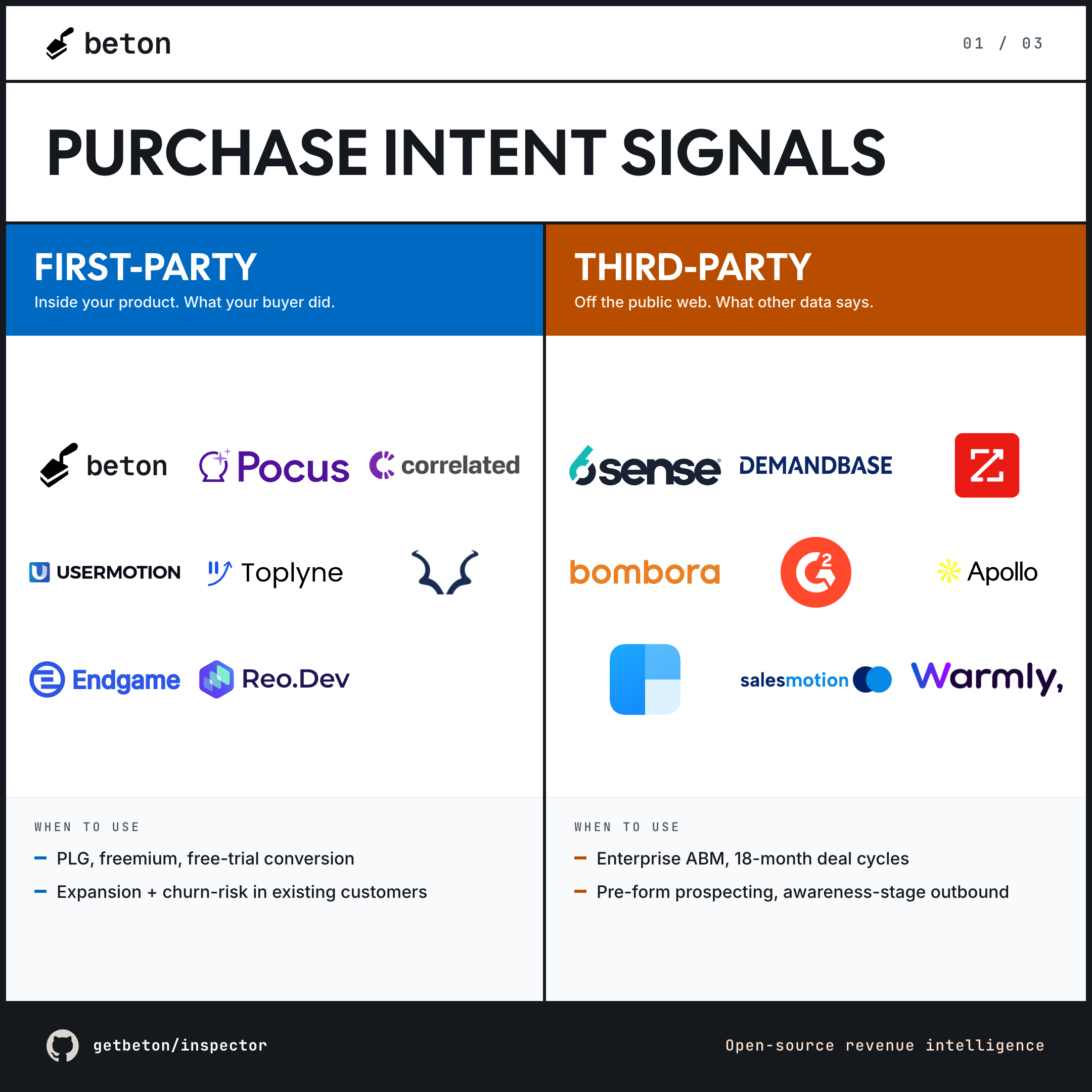
First-party vs third-party signals — and how to actually use them
Third-party intent is a category-level guess. First-party signals are the buyer using your product. Here's the operational difference, a working schema, the scoring model, and the false-positive math nobody publishes.
Frequently Asked Questions
Do I need to export my PostHog data to use Beton?
Does Beton slow down my PostHog instance?
Which PostHog event types does Beton analyze?
Does Beton store the raw PostHog events?
Ready to connect PostHog?
Start detecting revenue signals and routing them to PostHog in minutes.
Benchmark Beton on Your PostHog Schema
DryFit ships fifteen ground-truth-annotated PostHog datasets covering every major SaaS billing model. Drop one into your test harness and benchmark the agent deterministically.
Pairs well with
PostHog is the data source — pair it with a destination to actually route the signals Beton finds.

PostHog + Attio
Convert PostHog product behaviour into Attio deals and account fields the moment a signal fires.
Attio integration →
PostHog + Apollo
Turn PostHog buying signals into Apollo sequences targeting only the accounts likely to convert.
Apollo integration →
PostHog + Webhooks
Stream every fired signal as JSON to wherever you already orchestrate revenue work.
Webhooks integration →